
The Ultimate Guide to Marketing Hotels & Resorts to the Korean Market

Korean outbound travel is set to increase by 8% Year Over Year until 2028. Is your hotel prepared?
If you are a hospitality marketing professional, you know South Korea is one of the most biggest outbound travel markets in the world.
But how can you market to Koreans? And what are the tools that will help marketing strategy for hotels, resorts, and destinations?
In this ultimate marketing guide for a hotel or resort to capture Korean outbound travelers, I will cover all the tools you need to be successful.
How can I market my hotel to Korea?
“To market your hotel to Koreans, you must shift focus from Google to NAVER. This strategy prioritizes Naver paid ads, a brand NAVER blog (SEO), KakaoTalk for on-site promotions and return visits, Instagram and YouTube for top-of-funnel discovery. NAVER AI Briefing - NAVER’s response to Google AI Briefing - is also important. Success means optimizing for Naver’s algorithm, understanding the Korean travel research journey, and the Korean social media ecosystem.”
This guide serves as your ultimate guide to market your property to Korea.
1. NAVER Search Ads: Brand Ad & Powerlink (PPC)
If you search for your hotel on Google, you likely appear at the top. If you search for your hotel on Naver today, who owns the top slot?
Answer: paid PPC ads from OTAs like Agoda or Expedia, eating into your margins. Followed by that is NAVER Hotel (similar to Google Hotel) which aggregates booking data from Booking.com and other OTAs to provide real time prices for your hotel or resort.
But how can you take more control of your brand presence on the NAVER search results page? And how can you make sure you have more control of your brand presence on NAVER?
The short answer is that it’s not easy.
Naver is a "pay-to-play" ecosystem. The SERP above the fold is dominated by paid ads, influencer blogs, and other sources that the NAVER algorithm considers trustworthy and useful based on the search terms.
The good news is that you CAN have much more control over your hospitality brand on NAVER.
Learn more about how to take control of your brand on NAVER here.
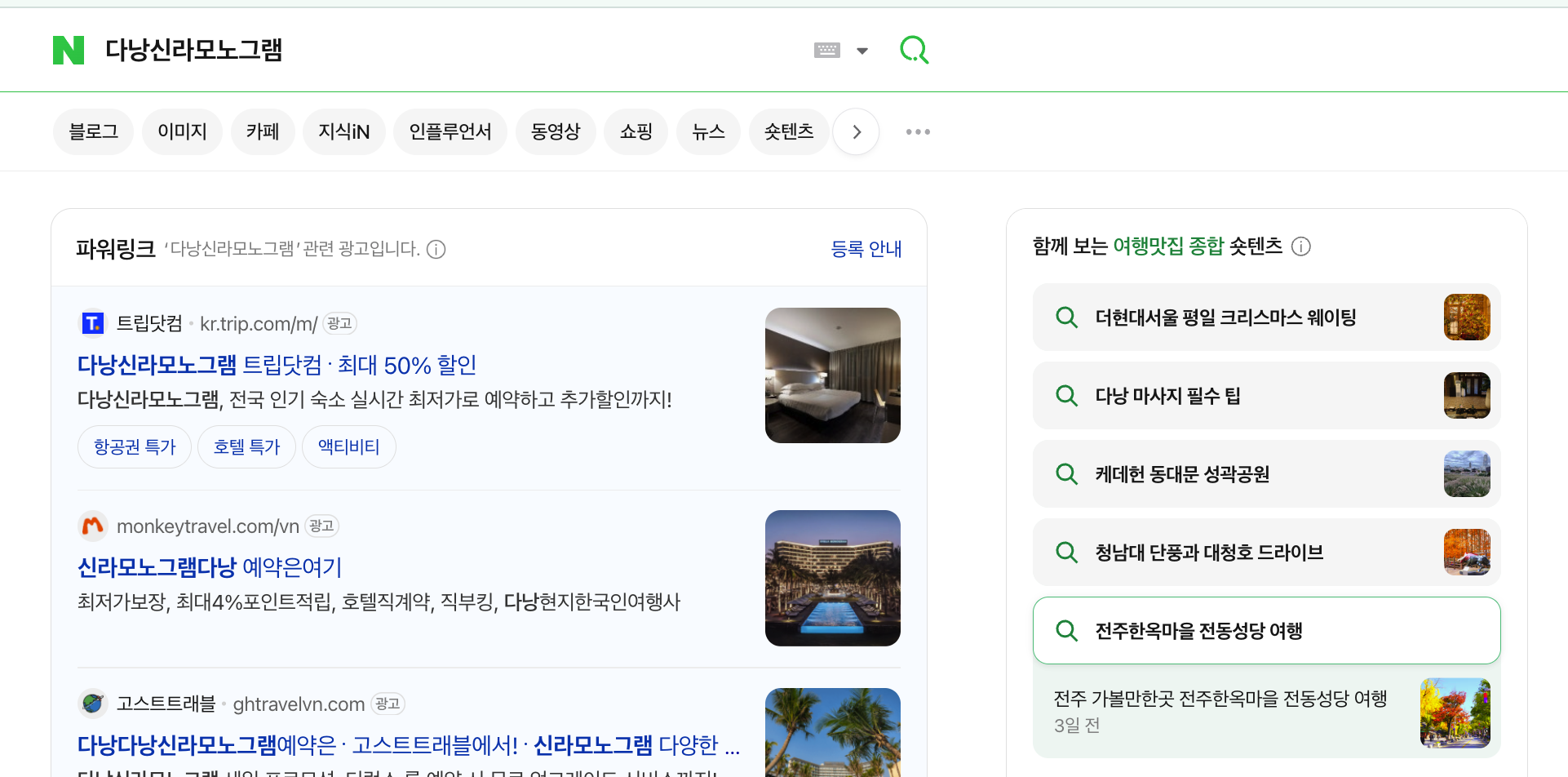
A typical NAVER SERP showing search keyword “Shilla Monogram.” The blue shaded areas below the search box are paid PPC ads for Trip.com, and other korean OTAs.
2. NAVER SEO for ranking on NAVER - for Hotels and Resorts
NAVER is not Google. For Korean travelers, it is the primary research environment—and its search results prioritize blogs, influencer content, Café communities, image modules, and platform-native signals above traditional website rankings. If your hotel or resort is not structurally visible inside NAVER’s ecosystem, you are effectively invisible to Korean outbound demand. Simply translating your website or relying on OTA listings is not a ranking strategy. Without intentional NAVER optimization, OTAs and third-party blogs shape your brand narrative—and capture your highest-intent traffic.
True NAVER SEO requires Korean-language authority building, ecosystem participation, and structured brand search control. Ranking is not about backlinks or global domain strength—it’s about relevance, engagement, and trust within NAVER’s closed platform architecture. For hotels and resorts targeting Korean travelers, mastering NAVER SEO means engineering visibility across multiple modules—not just aiming for a single organic listing.
Inside this article, we cover:
How NAVER’s algorithm differs from Google’s ranking model
Why NAVER Blog authority drives hotel visibility
Brand search optimization strategies to reduce OTA dominance
The role of influencer amplification in organic ranking
Café community engagement for niche travel segments
Multimedia integration (images & video) within NAVER search
A practical implementation roadmap for hotels and resorts
If Korean demand matters to your property, ranking on NAVER is not optional—it is foundational.
Read the full artilce here:
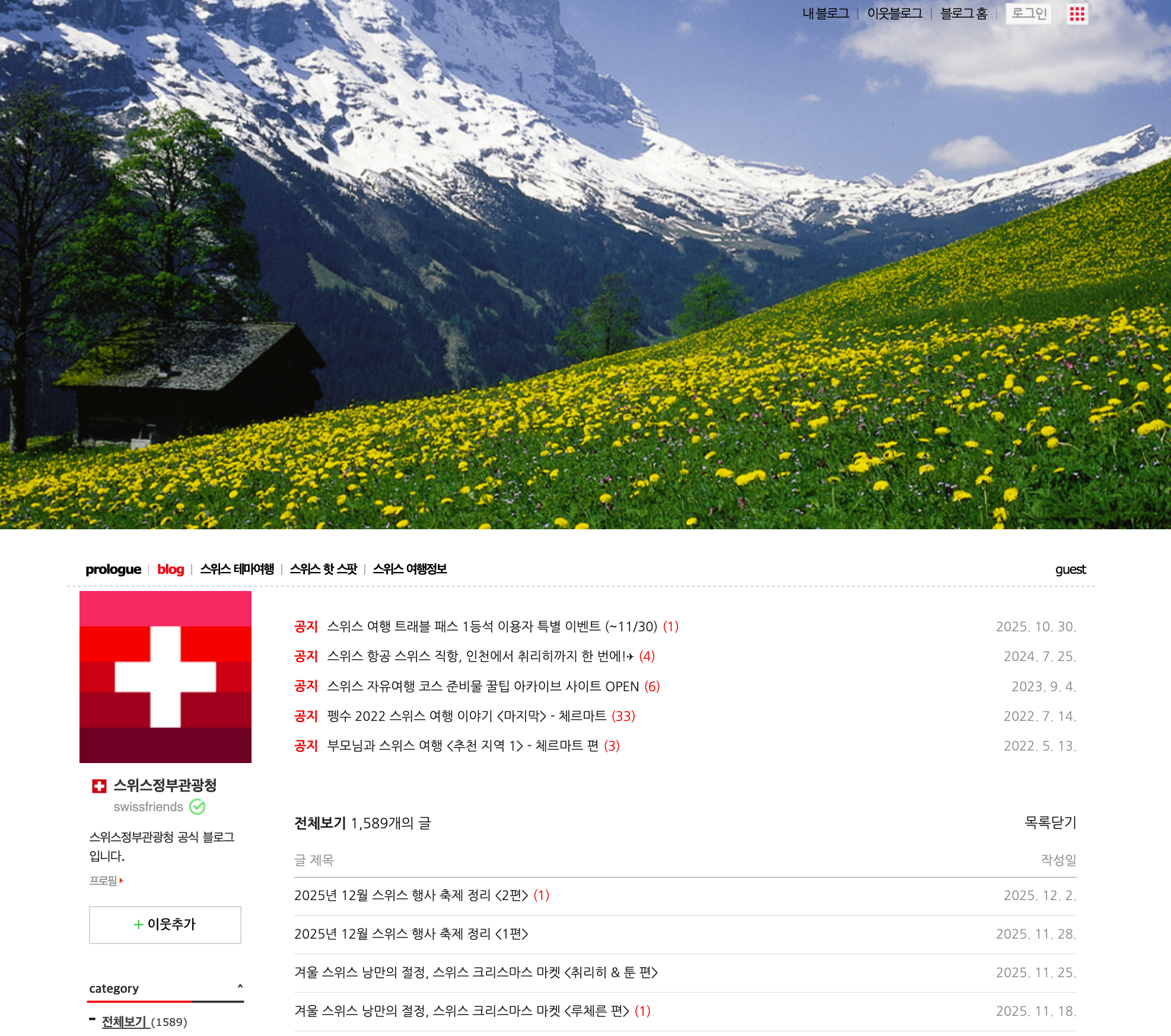
Swiss Board of Tourism Naver Blog is a highly trusted source of information for Koreans.
3. Press Releases for Hotels & Resorts
In South Korea, PR optimized for search visibility—especially on NAVER—delivers tangible benefits for foreign hotels and resorts. A Korean press release builds credibility and drives interest among tourism journalists, tourism platforms, and lifestyle websites, helping get information about a property into the Korean tourism ecosystem.
Key effects of Korean-language PR for foreign properties
Search visibility that drives discovery
NAVER indexing increases the chances Korean journalits will discover the hotel or resort and post an article.Enhanced brand trust before site visits
Exposure through local media and portal curation signals legitimacy. Korean users often interpret NAVER-listed coverage as third-party validation, which raises trustworthiness more effectively than standalone ads.Cultural and market relevance
Korean-language PR communications are important cues for travelers who prefer providers that understand their needs and speak their language.
For foreign hotels and resorts aiming to attract Korean guests, investing in targeted Korean PR is an important way to increase visibility, build credibility, and convert interest into action — and later, to bookings.
4. NAVER AI Briefing – NAVER's answer to Google AI Overview
Key takeaway: You must now optimize for NAVER’s AI Briefing.
NAVER has launched its answer to ChatGPT and Google Gemini—called AI Briefing—that now appears directly inside search results. This is the single biggest disruption in Korean search marketing in over a decade.
NAVER’s AI Briefing now scrapes top-ranking content across the NAVER ecosystem and generates a summarized answer for the user before they ever see a list of links. If your content isn’t structured in a way the AI can clearly “read,” or if there isn’t enough consistent, authoritative content about your brand or topic, the system will simply exclude you from the summary.
And being excluded from the AI Briefing isn’t the same as ranking low. It’s worse. It’s total digital erasure at the exact moment a traveler is researching where to stay.
This shift changes how hotels, resorts, and destinations must think about NAVER SEO—from keyword chasing to entity building, structured content, and long-term brand authority. If your Korean content strategy hasn’t adapted to Cue yet, you’re already falling behind.
5. NAVER Blog
If your website is your digital brochure, your NAVER Blog is the quiet engine that builds trust for your brand on NAVER—24/7. Korean travelers rarely book a high-ticket stay like a resort or luxury hotel based on a corporate website alone. They validate their decision by reading blogs: influencer blogs and your official brand blog.
In the Korean market, NAVER isn’t just a search engine—it’s a closed ecosystem. That means your visibility, credibility, and rankings depend heavily on how well you operate inside it. An official NAVER Blog plays two critical roles:
NAVER SEO (organic ranking): NAVER’s search results page (SERP) works very differently from Google’s. It strongly favors its own platforms, especially NAVER Blogs. When your content ranks through a NAVER Blog, it sends trust signals to the algorithm and dramatically increases your chances of appearing in high-visibility positions for travel-related keywords.
Brand “home base” on NAVER: Your NAVER Blog is the one place where you fully control your brand narrative. It becomes the authoritative source Koreans rely on for accurate, localized information about your property—rooms, dining, experiences, nearby attractions, and seasonal travel tips.
The real goal is to intercept travelers during their research phase with high-quality, storytelling content that feels personal, not corporate. Done right, your NAVER Blog quietly supports every other channel—ads, PR, influencers, and word-of-mouth. Without a NAVER Blog strategy, you’re relying almost entirely on luck to win Korean bookings.
6. Kakao Channel for F&B and spa + repeat visits
Everyone in Korea—nearly 99% of the population—uses KakaoTalk, making it the country’s most powerful communication platform by a wide margin. It’s far more than a simple messaging app. KakaoTalk functions as a lifestyle super-app that Koreans use daily for chatting, payments, shopping, bookings, notifications, and brand interactions.
For hotels and resorts, this creates a rare opportunity to engage Korean guests inside a platform they already trust and check constantly, rather than pushing them to unfamiliar apps, emails, or foreign websites they are unlikely to open.
A Kakao Channel gives hotels a smart, low-friction way to drive incremental spa and F&B revenue by connecting with guests at the right moment—on property. By promoting your Kakao Channel at check-in, guests can scan a QR code and instantly follow your brand, unlocking a clear, time-sensitive incentive to spend on-site.
For example, you could feature an exclusive “Summer Spa +20 minutes” voucher, available only through your Kakao Channel. This turns your Kakao Channel into a seamless upsell channel that feels personal, convenient, and native to how Koreans already interact with brands.
Long-term value: Keep guests in your channel so you can re-engage them later after checkout for future offers and communications.
Why Kakao Channel works so well for Korean guests:
Zero friction: No app downloads, logins, or new platforms to learn
High open rates: News Posts on your Kakao Channel are seen far more reliably than email or SMS
Feature all venue upsells on the Kakao Channel: spa, dining, and activity offers are always on their phone
Channel exclusivity: Vouchers feel special when only available via Kakao
On-property targeting: Promote high-margin services exactly when guests can use them
Long-term value: Retain guests in your channel for future re-engagement after checkout
7. Korean Instagram Strategy
For Korean travelers, Instagram is a visual search engine, second only to Naver. They search hashtags to check the current vibe of a location, figure out the cozy cafes, and find the hottest night spots and delicious restaurants.
But most importantly, they’re looking for images of your property.
Does your pool look clean? Is the food photogenic? "Instagrammability" is an important booking criteria.
But here is the key: You cannot just repost your global content. You need to understand how photography and captioning resonates with Korean sensibilities. A feed that looks "too Western" or "too corporate" might be scrolled past quickly.
[coming soon: Five Keys for Korean Instagram Effectiveness]
8. Korean YouTube
YouTube is now the most-used app in Korea by far. For hospitality, it is the ultimate immersion tool.
Korean travelers don’t make hotel or resort decisions based on photos and star ratings alone. Before booking a high-ticket stay, they watch full-length room tours, vlog-style walkthroughs, dining reviews, spa experiences, and “Get Ready With Me” travel prep videos to imagine what their own trip will feel like. In the Korean market, video isn’t a nice-to-have—it’s a primary trust signal.
High-quality video builds a level of certainty that text content can’t match. It shows scale, atmosphere, service quality, and real guest experience in a way no brochure ever can. But simply uploading an English brand video with Korean subtitles rarely works. Korean audiences are highly sensitive to pacing, tone, and storytelling style. To convert, your video content must feel culturally native—not just translated.
In short: in Korea, video isn’t just content. It’s proof. And without culturally native proof, even world-class resorts struggle to turn Korean interest into bookings.
9. Hotel & Resort Website Localization
Website localization differs from translation. Translation changes words from one language to another. Localization adapts the user experience (UX), currency, and cultural nuances to the target market. This is very important for NAVER and how you signal trust, because a website that relies on auto-translate plugins signals low quality and a lack of customer support.
If a potential guest clicks through from Naver to your website, and they see a "Google Translate" widget and slow loading speeds, they will bounce immediately. They will go back to Agoda to book your room, costing you 15-20% in commission. Professional localization is an investment in your Direct Booking channel.
[Coming soon: Why Professional Website Localization Matters—and how to do it.]
10. NAVER Social Listening
What are they saying about you behind your back?
Koreans are prolific reviewers, but they post much more definitive reviews on NAVER than they would on Google Hotel or Agoda or Booking.com. On NAVER, They post in Naver Blogs and NAVER Cafes (massive online communities with tens of thousands of members). There might be an influencer blog right now discussing your breakfast buffet, your check-in speed, or the cleanliness of your pool.
If you aren't engaging in Social Listening within these communities, you are missing a lot of very honest and valuable feedback. You need to know these sentiments so you can understand the issues— and sometimes respond directly.
[coming soon: Social Listening on NAVER, and why you should care]